

Most companies know they have operational gaps in their supply chain: missing shipment updates, data buried in spreadsheets, or delayed responses from partners. They just can’t agree on how to fix them.
The classic debate is then: should you build your own solution, or buy one off the shelf? IT teams argue for control and customization. Supply chain pushes for speed and vendor accountability. Meanwhile, operations are stuck patching together workarounds.
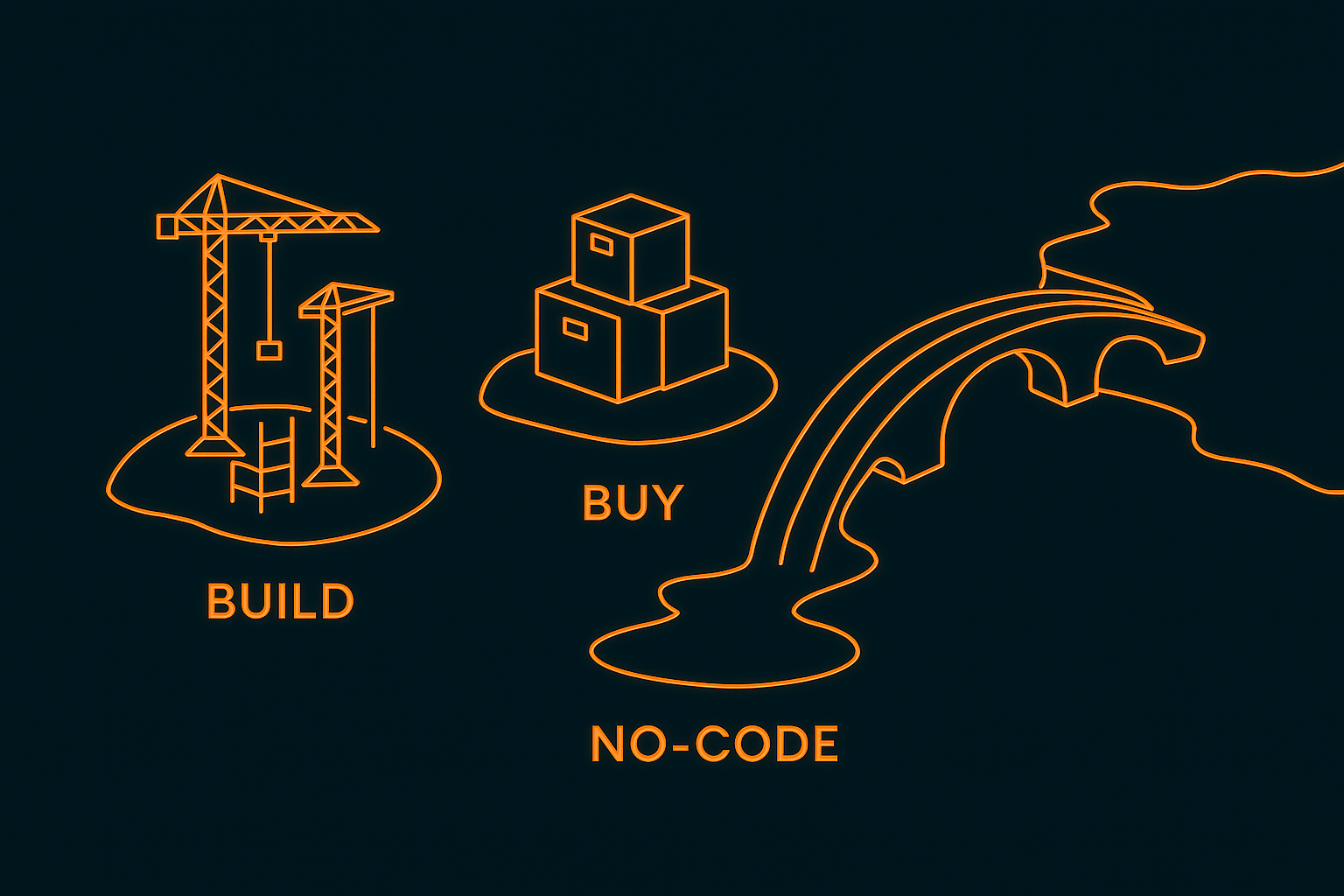
The reality is neither option works perfectly anymore. Building takes too long. Buying rarely fits. And the gaps keep growing. In this article, we’ll look at the classic build vs. buy debate — and then introduce a third path that many companies now use to fill gaps quickly: no-code.
The Gaps That Keep Growing
Supply chain gaps show up everywhere. In visibility, you can’t track a shipment or predict a delay before it becomes a customer crisis. In planning, procurement, logistics, and operations are all working from different data sets. In execution, manual processes and disconnected systems create bottlenecks that slow everything down.
Take cross-functional collaboration as an example. It’s the difference between procurement, logistics, and operations working as one coordinated unit versus three separate kingdoms. Good collaboration means faster decisions, fewer surprises, and the ability to adapt when something goes sideways.
But most companies are dealing with structural problems that make collaboration, and other critical capabilities — nearly impossible:
- Fragmented systems and shadow IT. Different teams use different tools. Data lives in silos that would make a medieval castle jealous.
- Zero integration across suppliers and carriers. Your TMS doesn’t talk to your freight forwarder’s system. Your 3PL sends updates via PDF.
- Manual data handling. Spreadsheets are still the lingua franca of logistics. They’re also error-prone and version-controlled by filename.
- Siloed communication. Operations in Germany doesn’t know what procurement in Singapore is doing. Everyone has their own version of the truth, and very often they don’t match.
These are structural problems that cost real money, create real delays, and prevent you from solving other issues, like improving forecasting accuracy, optimizing inventory placement, or automating exception management.
The Build vs. Buy Trap
Building: Control at a Cost
Building your own platform sounds appealing. Total control over design and features. Perfect fit. No compromises.
Large enterprises with vast IT resources sometimes go this route to tightly align software with proprietary processes. And there’s logic to it: if you’re competing on supply chain performance, shouldn’t you own the technology that powers it?
Except logistics isn’t the core business for most shippers: it enables the core business. A consumer electronics company should be innovating on products and customer experience, not building shipment tracking systems.
Custom projects take 6 to 18 months to deliver initial value. That’s if everything goes well. Most don’t. Requirements change. Key developers leave. Priorities shift. By the time you launch, the business problem you were solving has evolved into new ones.
And once it’s live? Your team owns everything. Maintenance, security patches, hosting, compliance updates, feature requests. IT becomes a permanent support desk for software that only your company uses.
The hidden cost isn’t just money. It’s opportunity cost. Every hour your IT team spends maintaining a custom shipment tracker or warehouse allocation tool is an hour not spent on strategic initiatives that actually differentiate your business.
Buying: Speed with Strings Attached
Off-the-shelf platforms promise the opposite. Fast deployment. Vendor-managed updates. Professional support. Implementation in weeks instead of years.
This works beautifully until it doesn’t, because off-the-shelf software is built for the average customer. Your supply chain isn’t average. You have unique routing rules, specific compliance requirements, legacy systems that can’t be replaced, and workflows that made sense 15 years ago and now nobody can change.
This results in time-consuming workarounds. Costly customizations. Integration projects that somehow take longer than the original implementation. You get speed to deployment but not necessarily speed to value.
And when the software doesn’t fit, you’re stuck choosing between changing your processes to match the tool, living with expensive gaps, or creating shadow IT solutions (Excel trackers, shared Google Sheets, and one-off workarounds that become permanent fixtures).
The Hybrid Answer: No-Code Platforms
There’s a third option that most companies overlook: don’t build everything, and don’t buy everything. Build what matters, integrate what exists, and use no-code tools to fill the gaps fast.
No-code platforms combine the speed of off-the-shelf software with the flexibility of custom builds. You get rapid deployment and lower upfront costs without sacrificing the ability to match your actual business processes.
However, there’s a critical distinction: not all no-code platforms understand supply chain. Generic platforms still require extensive configuration and domain expertise. What supply chain teams need is a no-code platform purpose-built for logistics, one that already speaks the language of shipments, carriers, inventory, and orders.
The difference shows up immediately in how these platforms work. The power sits in the interface. Drag-and-drop components. Pre-built templates. Business users with supply chain expertise can create functional applications without writing code. This turns domain experts into “citizen developers” who can solve their own problems without waiting for IT to clear the backlog.
Need to track shipments across multiple carriers with custom exception alerts? Build it in days, not months. Trying to automate freight cost validation across different rate cards? Configure the logic without touching code.
You’re not locked into anyone’s vision of how supply chains should work. You can iterate, adjust, and rebuild as your needs change. With direct control over the tools you use every day.
The Catch
No-code isn’t magic. Integration with legacy systems can still be challenging. Complex logic sometimes requires actual code. And business users building solutions doesn’t eliminate the need for IT — it shifts IT’s role from building everything to setting guardrails, ensuring security and compliance, and maintaining the platform that makes citizen development possible.
But for filling gaps quickly, whether that’s visibility, workflow automation, or data consolidation, it’s hard to beat. The time-to-value is dramatically faster, and you can always add more sophisticated functionality later.
A Practical Example: Speedboats
Traditional supply chain platforms are built like battleships. Powerful, comprehensive, and slow to turn. Logward Speedboats take a different approach: modular, agile, no-code solutions designed to deliver measurable results in weeks.
They’re built to integrate with your existing infrastructure without disruption. Business teams can configure and manage them independently. And because they’re modular, they adapt to your specific requirements and scale as you grow.
This is the hybrid model in action. Not a replacement for your core systems, but a fast, flexible layer that bridges the gaps your existing tools can’t reach, whether that’s visibility, cost control, or process automation.

How to Choose: A Decision Framework
Whether you’re considering build, buy, or no-code, the same factors matter. Weigh them honestly against your actual situation, not your ideal one.
1. Integration Readiness
Can it connect to your ERP, WMS, TMS, and CRM without heroic effort? Look for REST/SOAP API support, JSON/XML compatibility, and pre-built connectors for common systems. If integration requires custom middleware, factor that cost and time into your decision.
2. Customization and Flexibility
How easily can you adapt it to your workflows? Check for configurable logic, custom data fields, and adaptable interfaces. Logistics needs are specific: batch processing, complex routing rules, compliance requirements. Make sure the platform can handle them without coding workarounds.
3. Data Security and Compliance
Strong encryption, secure access controls, and compliance with industry security standards like SOC 2, and GDPR aren’t optional. Your supply chain data includes competitive information, customer details, and financial transactions. Treat security like the business risk it is.
4. User Training and Vendor Support
The best platform is useless if your team can’t use it. Look for vendors that provide training and dedicated technical support. You need people who can fully leverage the tool and resolve issues without creating a backlog.
5. Ease of Use and UX
If it’s not intuitive, people won’t use it. Period. Look for drag-and-drop interfaces that non-IT users can navigate. Mobile-friendly access for on-the-go updates. Clean dashboards that surface the information people actually need.
6. Automated Updates and Maintenance
The platform should handle updates automatically with minimal IT involvement. Make sure the operational burden is clear before you commit.
Your Checklist
Before making a decision, answer these questions honestly:
- How fast do we need results? (Weeks, months, or can we wait a year?)
- What’s our IT team’s capacity for ongoing maintenance?
- How unique are our requirements versus industry standard processes?
- What’s the cost of doing nothing and living with current gaps?
- Can we integrate with existing systems without replacing them?
- Who will actually use this, and what’s their technical skill level?
If you want deeper guidance, check out Logward’s Buyer’s Guide. It covers how no-code technology is reshaping supply chain execution, key benefits and implementation considerations, critical evaluation factors including security and governance, and real-world use cases in transport planning, order management, and freight cost control.
The Takeaway
Build vs. buy isn’t the right question anymore. The right question is: what combination of build, buy, and configure gets us the capabilities we need fastest with the least ongoing burden?
For most companies, that means a hybrid approach. Keep your core systems. Integrate where it makes sense. Use no-code platforms to bridge gaps quickly and adapt as needs change.
Your supply chain doesn’t need a five-year IT project. It needs solutions next quarter. Maybe next month.
Stop debating. Start filling the gaps.