


If you’re like us – always seeing the logistics behind daily life – you’ve probably found yourself at an airport between connecting flights, wondering how your luggage gets to your final destination.
What’s happening behind the scenes while you’re sprinting to your next gate?
Whether you’ve pondered this question or not, luggage handling in a busy airport is a masterclass in supply chain execution – all without anyone manually touching a conveyor belt, much like modern supply chains that rely on smart solutions.
The Baggage System is a Supply Chain in Miniature
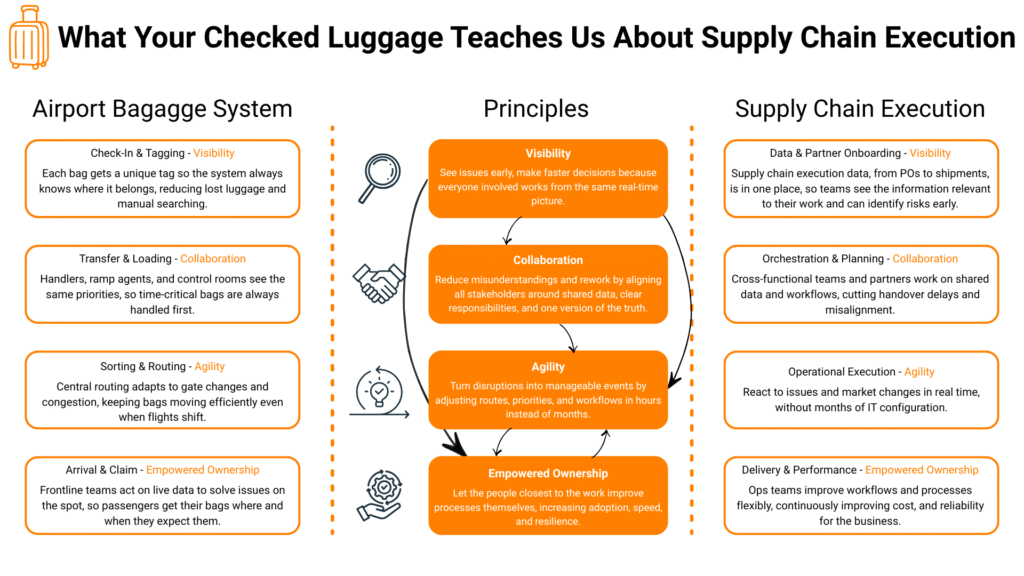
An airport baggage handling system is, fundamentally, a supply chain operation. Thousands of items need to move through multiple physical locations, be directed toward different final destinations, and be ready at precisely the right moment. Airports achieve this with remarkable consistency. How do they pull this off? Through four interconnected capabilities that every supply chain should aspire to: visibility, collaboration, agility, and empowerment.
Visibility: Knowing Where Everything Is, In Real Time
The moment your baggage is tagged at check-in, it enters a tracking system. That 10-digit barcode (increasingly reinforced by RFID technology) encodes your complete journey: final destination, connecting flights, routing instructions, priority level.
As your bag moves through the system, it’s scanned at multiple points. The control system knows, at any moment, where your bag is, where it’s going, and whether it’s on track to make its connection.
This visibility enables everything else. It allows the system to instantly classify bags as local arrivals, transfers, or time-critical rush bags. It enables handlers to prioritize which bags to unload first. It allows the routing system to direct bags along optimal paths based on real-time congestion.
The same principle applies to larger supply chains. When visibility extends across orders, inventory, and transportation in real time, coordination and, more importantly, action become possible. With modern supply chain platforms teams can track shipments just like baggage scanners track luggage. They can see a delayed container and find alternative ways to meet customer commitments—visibility and execution working together across the network.
Collaboration: When All Stakeholders Act in Sync
Here’s what’s remarkable about airport baggage systems: handlers, system operators, aircraft crews, loading teams, and supervisors all operate with the same real-time information about what each bag needs and when it needs to arrive. When a handler unloads a time-critical transfer bag, they know it’s time-critical. When the loading team prepares the Unit Load Devices (airline cargo containers), they know the loading sequence.
This is true collaboration built on shared data. Everyone has context. Everyone can make decisions that account for what others are doing.
Modern supply chain collaboration works the same way. Procurement teams share forecasts with suppliers so they can adjust capacity. Warehouse managers coordinate with transportation providers so shipments are staged at the right moment. Carriers participate in real-time optimization of route planning and consolidation.
When this works, it’s powerful. But it requires everyone operating from the same information set, not silos of partial knowledge.
Operational Agility: Systems That Respond to Real Conditions
Airport baggage systems aren’t static. Nowadays, when multiple aircraft arrive simultaneously, AI-driven routing systems proactively rebalance workload. Bags are rerouted from congested conveyor belts to alternate paths. Sorting priorities shift dynamically.
This is what adaptability looks like: systems that respond to actual conditions rather than following rigid plans.
More sophisticated supply chains should work the same way. When your business changes or market conditions shift, your supply chain ecosystem should adapt with the changes – not require months of IT configuration or custom development to respond to what’s happening right now.
Empowered Ownership: Frontline Teams Have Control
The baggage handlers unloading aircraft are responding to priority information from the system. The sorters routing bags are executing decisions based on real-time data.
Frontline teams are not waiting for someone else to make decisions or configure processes. They’re empowered to execute efficiently because they have the right information, the right priorities, and the right tools at their fingertips.
The same should be true in more complex supply chains. Procurement teams shouldn’t, for example, manually negotiate with ten suppliers for the best quote – their tools should surface options already ranked by key criteria like past performance and lead times. And teams shouldn’t wait for IT to configure solutions to face changing conditions. No-code platforms put this control directly in the hands of the teams doing the work: they can modify processes, adjust priorities, and respond instantly.
In this way execution becomes more efficient, more responsive, and more resilient.
Putting It Together: Visibility, Collaboration, Operational Agility, Empowered Ownership
Baggage handling systems work because they weave together four principles:
- Visibility that gives everyone real-time access to the information they need
- Collaboration that enables stakeholders across the network to work toward common objectives
- Operational Agility that lets teams respond to actual conditions
- Empowered Ownership that gives frontline teams control over their workflows
These are the foundations of any supply chain that can scale efficiently, respond to disruption, and deliver what customers need when they need it.
The No-Code Approach to Supply Chain Execution
This is why the shift toward integrated supply chain execution platforms matters.
They provide visibility across the entire network, with role-based access ensuring each stakeholder sees the information relevant to their work—nothing more, nothing less. They create collaboration frameworks where stakeholders can share data and work toward common objectives. They enable operational agility through processes that adapt when business or market conditions change. Thanks to no-code technology they also enable empowered ownership by giving frontline teams the tools to control and promptly improve their workflows without waiting for IT.
Because that’s what your checked luggage has figured out: the most efficient execution doesn’t come from perfect prediction or rigid planning. It comes from being able to see clearly, work together, adapt quickly, and empower the people doing the work.
The next time your baggage arrives at your connecting gate before you do, remember—your supply chain could run just as smoothly.